
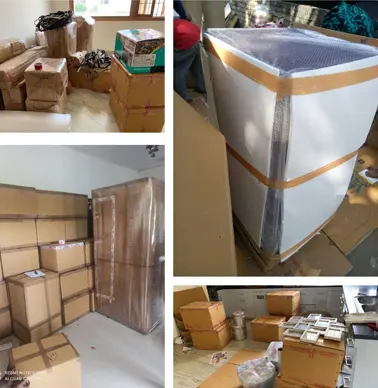
<p>Most breakage on a house move happens in the kitchen, and almost all of it is avoidable. The reason kitchens are risky is that they contain three different categories of object — hard and breakable, heavy and awkward, and small and easily lost — and most people pack them as if they are all the same.</p>
<h2>Pack in this order</h2>
<p>Start with the things that will not be needed for the first few days, and work towards the everyday crockery. That way the first box you unpack is the one you actually need, and the fragile seasonal items stay buried safely at the bottom.</p>
<ol>
<li><strong>Seasonal and decorative items</strong> — festival ware, glass decor, the good serving bowls. These are the most breakable and the least needed on arrival.</li>
<li><strong>Small appliances</strong> — mixers, grinders, toasters, irons. These go in their own cartons with padding, not loose in a big box.</li>
<li><strong>Large appliances</strong> — fridge, washing machine, microwave. These are moved by the crew on a trolley; do not put loose items inside them, and let us know at booking so we plan the handling.</li>
<li><strong>Dried goods and spices</strong> — leak-proof bags inside double bags, upright, tight, and away from anything that can crush.</li>
<li><strong>Everyday crockery and glass</strong> — wrapped individually, then boxed, then padded between the layers. Not together.</li>
</ol>
<h2>Wrap glass individually, then again</h2>
<p>Wrapping plates together in one sheet is the single most common packing mistake. A stack moves as a single unit, so one chip cracks the entire stack. Wrap every plate and bowl separately, nest them with padding between layers, and never fill a carton more than three-quarters — a full carton is a carton that gets dropped.</p>
<h2>What must not go in a carton at all</h2>
<ul>
<li><strong>Knives, scissors and blades</strong> — these are a genuine safety risk for the crew. Hand them over separately at the start of the job.</li>
<li><strong>Documents, certificates, passports and title deeds</strong> — keep these on your person.</li>
<li><strong>Medicines</strong> — you do not want to unpack a carton searching for a prescription.</li>
<li><strong>Valuables, cash, laptop and chargers</strong> — personally carried, never packed.</li>
<li><strong>Anything with a data source you cannot recreate</strong> — a single-use external drive is not a copy of your data.</li>
</ul>
<h2>Label the carton, not just the room</h2>
<p>Write the room name and a short contents line on every carton — "kitchen upper shelf", "kitchen base jars". A numbered inventory sheet handed to you at delivery makes it obvious at a glance if something is missing, while you are still standing in the doorway.</p>
<h2>One honest note on the fridge</h2>
<p>Modern refrigerators need to stand upright for several hours before you plug them back in after a move. Tell us in advance if a fridge is involved, and follow the manufacturer's guidance on wait time before switching on.</p>
<h2>Pack in this order</h2>
<p>Start with the things that will not be needed for the first few days, and work towards the everyday crockery. That way the first box you unpack is the one you actually need, and the fragile seasonal items stay buried safely at the bottom.</p>
<ol>
<li><strong>Seasonal and decorative items</strong> — festival ware, glass decor, the good serving bowls. These are the most breakable and the least needed on arrival.</li>
<li><strong>Small appliances</strong> — mixers, grinders, toasters, irons. These go in their own cartons with padding, not loose in a big box.</li>
<li><strong>Large appliances</strong> — fridge, washing machine, microwave. These are moved by the crew on a trolley; do not put loose items inside them, and let us know at booking so we plan the handling.</li>
<li><strong>Dried goods and spices</strong> — leak-proof bags inside double bags, upright, tight, and away from anything that can crush.</li>
<li><strong>Everyday crockery and glass</strong> — wrapped individually, then boxed, then padded between the layers. Not together.</li>
</ol>
<h2>Wrap glass individually, then again</h2>
<p>Wrapping plates together in one sheet is the single most common packing mistake. A stack moves as a single unit, so one chip cracks the entire stack. Wrap every plate and bowl separately, nest them with padding between layers, and never fill a carton more than three-quarters — a full carton is a carton that gets dropped.</p>
<h2>What must not go in a carton at all</h2>
<ul>
<li><strong>Knives, scissors and blades</strong> — these are a genuine safety risk for the crew. Hand them over separately at the start of the job.</li>
<li><strong>Documents, certificates, passports and title deeds</strong> — keep these on your person.</li>
<li><strong>Medicines</strong> — you do not want to unpack a carton searching for a prescription.</li>
<li><strong>Valuables, cash, laptop and chargers</strong> — personally carried, never packed.</li>
<li><strong>Anything with a data source you cannot recreate</strong> — a single-use external drive is not a copy of your data.</li>
</ul>
<h2>Label the carton, not just the room</h2>
<p>Write the room name and a short contents line on every carton — "kitchen upper shelf", "kitchen base jars". A numbered inventory sheet handed to you at delivery makes it obvious at a glance if something is missing, while you are still standing in the doorway.</p>
<h2>One honest note on the fridge</h2>
<p>Modern refrigerators need to stand upright for several hours before you plug them back in after a move. Tell us in advance if a fridge is involved, and follow the manufacturer's guidance on wait time before switching on.</p>
Copies of this guide are useful, but a price has to come from a goods list. Ask for a free written quote .